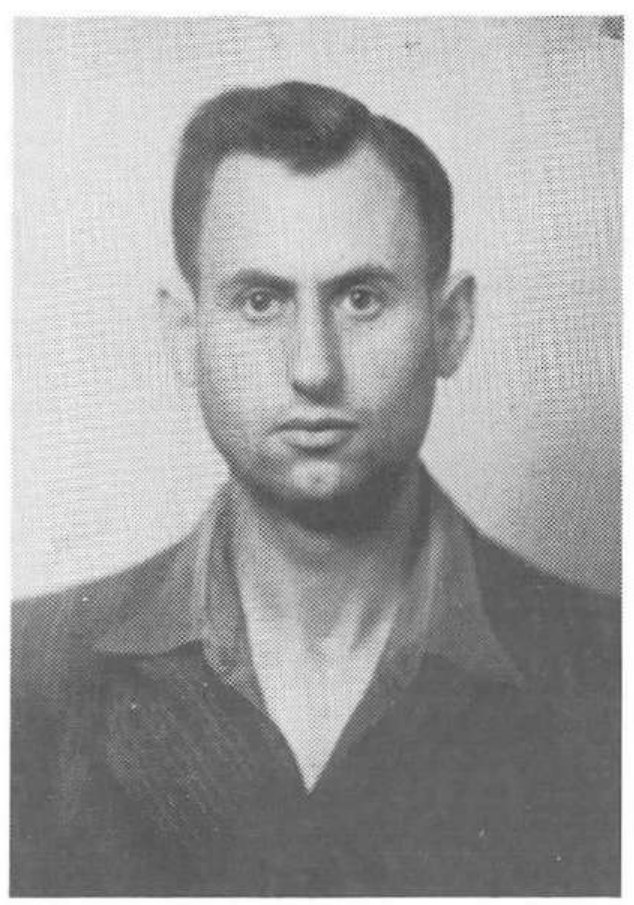
A grain merchant's son in Brześć Kujawski
Baruch Gajc was born on 21 May 1921 in Brześć Kujawski, a small town in the Kujawy region of central Poland, near Włocławek. He was the third of four children of Alexander Ziskind Gajc, a grain merchant, and Rivka née Rydel. His sisters Zivia and Chava were born in 1918 and 1919, and his brother Naftali in 1923. At home he was Boruch; in Polish, Bolek.
Fort Radziwill, where his father died
In January 1940 the Gestapo arrested him in his home town and put him in a local forced-labour camp. In June 1941 he was moved to the labour camp at Fort Radziwill in Poznań. His father was held there too, and died there on 18 March 1942. Bolek was twenty.
His mother, his two sisters and his brother were murdered in the same years. When he filled in their Pages of Testimony in 1999, he wrote the place of death as Chełm.
Auschwitz 138273
In August 1943 he was sent to Auschwitz and registered as prisoner 138273. He escaped once and was caught, and was put in the camp's penal company, a punishment few survived.
A borrowed name: "Bolek Guy"
By January 1945 the camps were being emptied westward, and Buchenwald was overflowing. When the prisoners were registered again, a group of young Jews from Auschwitz decided to pass as non-Jewish Poles. Each chose a false name that sounded like his own, so it would be easy to remember. Baruch Gajc gave his name as Bolek Guy.
As a "Pole" he was sent not to Theresienstadt with the Jews but to the work camp at Leitmeritz (Litoměřice). He never gave the name up. His son was born a Gaje in Czechoslovakia and grew up a Guy in Israel.
The coal train to Holešovice
In the spring of 1945 Bolek, Avraham Hershalom (19) and Dudek Moskovitch (23) joined a passenger transport out of the camp, meaning to jump. At a stop beside a coal train they crossed over and lay flat on the coal. The train took them to the Holešovice coal yards in Prague. They arrived in prison stripes, shaved and starving.
The Sobotkas, the flower shop, the uprising
A midwife, Jiřina Sobotková, and her family took the three in, fed them and hid them, and then moved them to the back room of a flower shop for about three weeks; friends of the family brought food in turns. In May 1945 all three joined the Prague Uprising against the Germans.
Bolek never forgot the Sobotkas. In 1963 he, Hershalom and Moskovitch saw her recognised by Yad Vashem as Righteous Among the Nations, and brought her to Israel to plant her tree.
Perla, Ústí, and a two-kilogram baby
In Prague, after the war, he met Perla Weiss, a survivor from Subcarpathian Ruthenia. By July 1945 they were living in Ústí nad Labem, where Bolek worked as a guard at the internment camp. Their son Miloslav, later Meir, was born on 13 May 1946, weighing just over two kilograms; "Grandma Sobotková" looked after him until he was out of danger.
A builder in Herzliya
In May 1949 Bolek took the train to Bari and sailed for Israel. Perla and Meir went to the United States first and joined him about six months later. By 1954 the family lived in Herzliya, where their daughter Ronit was born that December. Recorded as a tailor in 1954, Bolek became a successful building contractor.
On 11 June 1999, at home on Dov Hoz Street, he and Perla filled in Pages of Testimony for their murdered families. Bolek died on 22 February 2006, the same day as Aviva Nahmany, his grandson Alon's other grandmother, about fifteen minutes apart. He is buried at Kfar Shmaryahu.